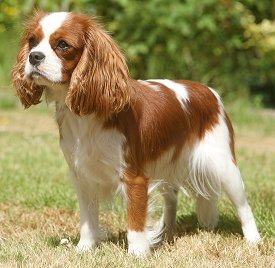
Patella luxation is a condition that involves repetitive dislocation of the patella (knee cap). It is seen in all types of dog but is most common in toy and miniature breeds of dog, such as the Cavalier King Charles Spaniel. It is also thought to be more common in females than males. Symptoms include abnormal movement in the hind limbs, lameness, skipping, and an abnormal posture while sitting. Clinical symptoms can be seen in dogs as early as four moths old. It is usually diagnosed during a physical examination from a veterinarian and is then confirmed by an x-ray. It is thought that it can lead to ruptured cranial cruciate ligament in 15-20% of cases. Dogs with intermittent or permanent lameness will be considered for surgery but most cases will be treated with pain killers, physiotherapy, and/or weight management.
Keratoconjunctivitis sicca (KCS)
KCS (also known as dry-eye syndrome) is a disease that affects the precorneal tear film and prevents the production of moisture in the eye. It results in the inflammation of the cornea and tissues in the eye due to dryness. It is thought to affect around 1% of dogs. The Cavalier King Charles Spaniel is one of the breeds more commonly affected, along with breeds such as pugs and the English bulldog. Symptoms include redness and yellow/green discharge. If untreated it will eventually result in a cloudy film over the cornea and scarring around the eye. It can cause blurred vision, or loss of vision completely and causes the eyes to be more prone to infection. It can be diagnosed by a schirmer tear test which checks whether there is adequate tear production in the eye. KCS can not be cured and requires life long medication. Two commonly used medicines are cyclosporine and tacrolimus which must be administered in the eyes once or twice a day, every day.
KCS (also known as dry-eye syndrome) is a disease that affects the precorneal tear film and prevents the production of moisture in the eye. It results in the inflammation of the cornea and tissues in the eye due to dryness. It is thought to affect around 1% of dogs. The Cavalier King Charles Spaniel is one of the breeds more commonly affected, along with breeds such as pugs and the English bulldog. Symptoms include redness and yellow/green discharge. If untreated it will eventually result in a cloudy film over the cornea and scarring around the eye. It can cause blurred vision, or loss of vision completely and causes the eyes to be more prone to infection. It can be diagnosed by a schirmer tear test which checks whether there is adequate tear production in the eye. KCS can not be cured and requires life long medication. Two commonly used medicines are cyclosporine and tacrolimus which must be administered in the eyes once or twice a day, every day.
Syringomyelia
Chiari-like malformation (CM) is a condition seen in cavaliers causing their brain to be too big for their skull. The back part of their skull puts pressure on the brain and some of the brain is squeezed out the back of the skull (foramen magnum). This is known as syringomyelia when the skull partially blocks the flow of cerebrospinal fluid from the brain, which is pushed through the central spinal canal. This causes a variation in pressure and creates fluid-filled cavities within the spinal cord, known as syrinx.
It is thought that this produces a pins-and-needles feeling around the head, neck and spine, while in severe cases it is thought to cause a burning sensation. Symptoms include being sensitive to touch, walking/moving slowly, problems jumping, scratching, phantom scratching, biting hind legs, or weakness in limbs. The symptoms seem to be worse during exercise, when excited, at night, and can even worsen due to changes in weather. It is thought that this is because of the changes in atmospheric pressure. It can be diagnosed by an MRI scan but there is no cure. Some dogs may have surgery to remove the back parts of the skull which are putting pressure on the brain. This will result in an improvement in about 80% of dogs, but 50% of these will have symptoms recurring within 2 years. In the most severe cases the dog will have to be euthanised as the condition is so painful. It is most commonly found in cavaliers and other toy breeds such as pugs, chihuahuas and yorkshire terriers. Symptoms will usually be seen after 2 years of age and a study showed that about 70% of cavaliers will have syringomyelia by the age of seven. It is a progressive illness which means it will get worse with time. It may end up destroying parts of the spinal cord, and the dog's legs will become progressively weaker. Some medications may be given to help limit the pain and reduce symptoms. Dogs with syringomyelia prefer to have their head elevated so keeping food and water bowls raised can help make them more comfortable.
Video of cavalier with syringomyelia:
https://www.youtube.com/watch?v=_UGp45LMCis
 |
| Syringomyelia MRI http://cavalierhealth.org/syringomyelia.htm |
It is thought that this produces a pins-and-needles feeling around the head, neck and spine, while in severe cases it is thought to cause a burning sensation. Symptoms include being sensitive to touch, walking/moving slowly, problems jumping, scratching, phantom scratching, biting hind legs, or weakness in limbs. The symptoms seem to be worse during exercise, when excited, at night, and can even worsen due to changes in weather. It is thought that this is because of the changes in atmospheric pressure. It can be diagnosed by an MRI scan but there is no cure. Some dogs may have surgery to remove the back parts of the skull which are putting pressure on the brain. This will result in an improvement in about 80% of dogs, but 50% of these will have symptoms recurring within 2 years. In the most severe cases the dog will have to be euthanised as the condition is so painful. It is most commonly found in cavaliers and other toy breeds such as pugs, chihuahuas and yorkshire terriers. Symptoms will usually be seen after 2 years of age and a study showed that about 70% of cavaliers will have syringomyelia by the age of seven. It is a progressive illness which means it will get worse with time. It may end up destroying parts of the spinal cord, and the dog's legs will become progressively weaker. Some medications may be given to help limit the pain and reduce symptoms. Dogs with syringomyelia prefer to have their head elevated so keeping food and water bowls raised can help make them more comfortable.
Video of cavalier with syringomyelia:
https://www.youtube.com/watch?v=_UGp45LMCis